Episcopal Community Services

DIGNITY. RESPECT. INTEGRITY. COMPASSION.

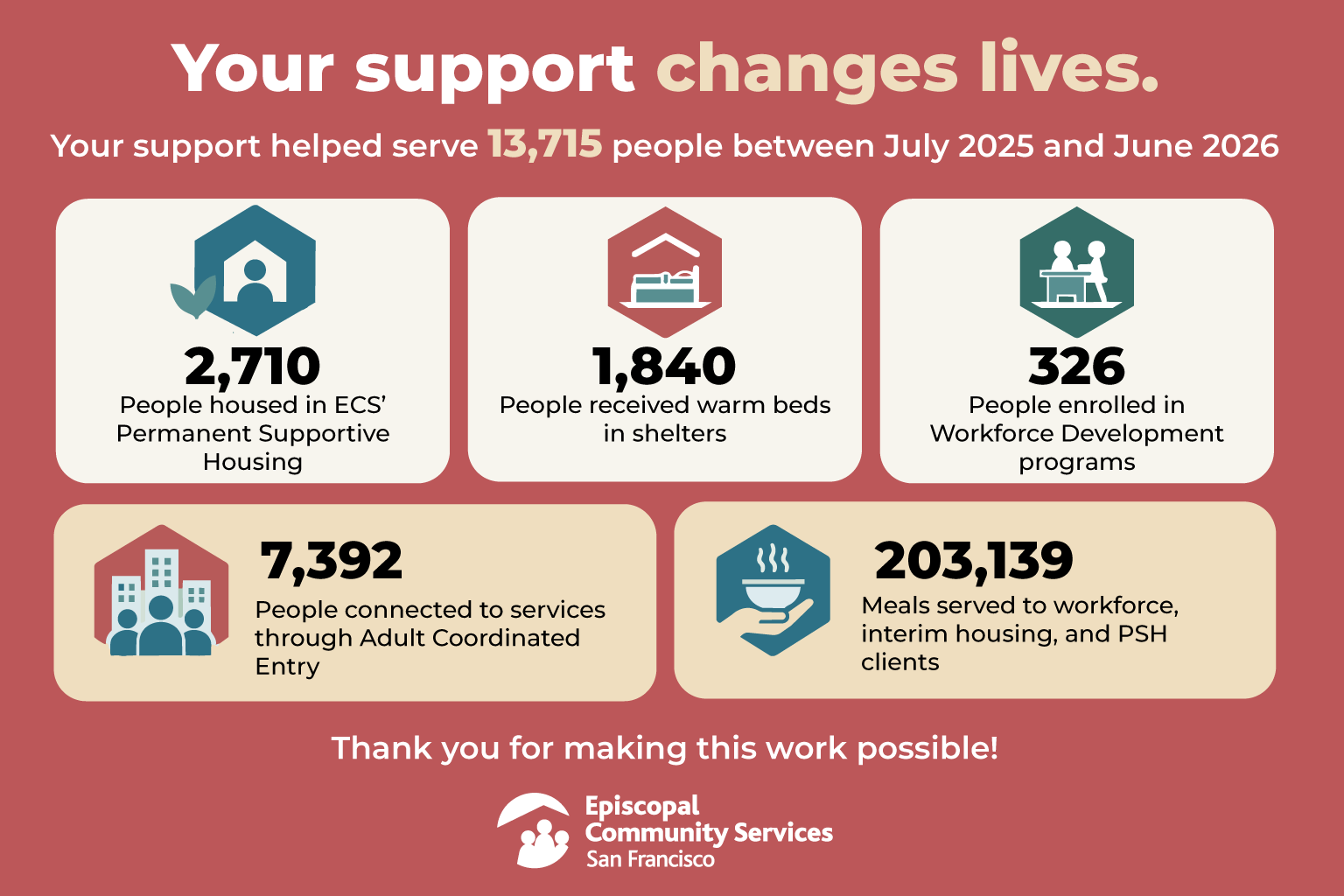
Episcopal Community Services (ECS) has provided essential services to individuals and families experiencing homelessness in San Francisco since 1983, utilizing a holistic approach that addresses the multiple causes leading to homelessness. This past year, we served more than 13,000 people across four counties in the San Francisco Bay Area, guided by our mission to help homeless and very low-income people every day and every night obtain the housing, jobs, shelter, and essential services each person needs to prevent and end homelessness.


IMPACTING COMMUNITIES
LIVED EXPERIENCES OF HOMELESSNESS

Shardonnae

Moving her family forward

“I am very grateful for ECS, because they helped me find a job, go back to school, and have a career."

EJ

Focused on success

“I learned to set up for success before beginning any task, minuscule or major."

Sabrina

Now has a place to call home

“I was tired of the streets, the difference is this place. They don’t give up on you.”

IN THE NEWS
By development January 21, 2026
In 2001, graduate student Scott Ecker bumped into a former supervisor who happened to be a new Support Services Manager at ECS. He asked if Scott was looking for a job, and before he knew it, Scott was providing case management services to seniors at an ECS permanent supportive housing site. What has kept him here since then? “My belief in our mission, and the idea that I can play an active part in changing lives,” he says. What are the roles at ECS you’ve had over the years? I started at ECS over 24 years ago on June 4, 2001, as a case manager at the Le Nain (a former ECS site), and then became the Support Services Manager at Canon Kip Community House in 2002. In addition to managing Canon Kip, from 2002-2010, I acted as the Support Services Manager at the Elm, the Crosby, Folsom-Dore Apartments (former ECS site) and Bishop Swing Community House. I became the Director for the Housing Services department in 2010, and I’ve been in this role since, now as Senior Director. What are some important changes you've seen ECS undergo over the years? Tremendous growth. When I started at ECS in 2001, we provided services at four permanent supportive housing sites, two shelters, and Canon Kip Senior Center. Since that time, ECS’s Housing Services Department now provides case management services at 23 housing sites, including regional expansion to Marin and San Mateo Counties. The years have seen the addition of Adult Coordinated Entry, the Behavioral Health Team, Scattered Sites Housing, and the Workforce Development department, including the CHEFS, REACH, and the IPS programs. What keeps you coming in to the office every day? The belief that every person has value, deserving dignity, stability, and the chance to heal and rebuild their lives in their own home. Many of the individuals and families we serve have endured extraordinary challenges--homelessness, behavioral health struggles, trauma, substance use, and the stigma that often comes with those experiences. Yet when I consult with staff regarding a client, or during those moments where I’m able to connect with a tenant, I am reminded that every resident has a story, with potential and strengths, and with hopes for the future. I come to work every day because I want to be a witness to those stories. I want to support a program that assists our tenants in reaching milestones, big or small, that are significant to them--like reconnecting with family, participating in a group activity for the first time, or simply feeling at home in their own housing unit. I also come to work to partner with our staff who do this work with such compassion and resilience. Supporting them, however I can, so they can show up fully for tenants is an important part of my role, and one that I take very seriously. Knowing that I can play a part in supporting both our tenants and our staff grounds me and gives purpose to the work I do every day. What are some important changes you've seen ECS undergo over the years? Tremendous growth. When I started at ECS in 2001, we provided services at four permanent supportive housing sites, two shelters, and Canon Kip Senior Center. Since that time, ECS’s Housing Services Department now provides case management services at 23 housing sites, including regional expansion to Marin and San Mateo Counties. The years have seen the addition of Adult Coordinated Entry, the Behavioral Health Team, Scattered Sites Housing, and the Workforce Development department, including the CHEFS, REACH, and the IPS programs. What keeps you coming in to the office every day? The belief that every person has value, deserving dignity, stability, and the chance to heal and rebuild their lives in their own home. Many of the individuals and families we serve have endured extraordinary challenges--homelessness, behavioral health struggles, trauma, substance use, and the stigma that often comes with those experiences. Yet when I consult with staff regarding a client, or during those moments where I’m able to connect with a tenant, I am reminded that every resident has a story, with potential and strengths, and with hopes for the future. I come to work every day because I want to be a witness to those stories. I want to support a program that assists our tenants in reaching milestones, big or small, that are significant to them--like reconnecting with family, participating in a group activity for the first time, or simply feeling at home in their own housing unit. I also come to work to partner with our staff who do this work with such compassion and resilience. Supporting them, however I can, so they can show up fully for tenants is an important part of my role, and one that I take very seriously. Knowing that I can play a part in supporting both our tenants and our staff grounds me and gives purpose to the work I do every day. What’s your favorite part of the job? These days it's when I have the opportunity to connect directly with line staff and tenants. As a director, a lot of my work is administrative, done from my desk or in meetings. Talking with staff about the great work they're doing, and partnering with them on interventions allows me to feed my need to be involved in the work and flex that therapeutic muscle. I also really appreciate those moments when I get to talk with a tenant, learn about their experiences, and make myself available to assist where I can. What are some important lessons you've learned throughout your time here? I've learned that resilience is everywhere. Even when faced with trauma, illness, or systemic barriers, many people show an extraordinary ability to endure and adapt. I have learned that change takes time. Healing doesn’t happen overnight. Patience and persistence are essential. Housing is just the start. The real work continues after someone has a roof. Support, community, and belonging are what sustain stability. What does a “good day” look like for you? It's always welcome news to hear about a staff accomplishment or a tenant success story, which reminds me of why we do the work. While rewarding, this work can be hard. So a good day usually includes a moment of levity--a joke in a staff meeting, a funny story shared with a colleague in the hallway...a good laugh with my work family goes a long way in making a hard day a little less heavy. What do you do on the hard days? I try to connect with someone I trust to process and put things in perspective. A walk around the block can often work wonders. Outside of work, I take care of myself through exercise, travel, going dancing and to festivals, and spending quality time with my partner, our dog, and our three cats. This is how I nourish my soul and recharge my battery. Anything else you’d like to share? We not only provide housing and services but also restore dignity, hope, and possibility to those we serve. I am deeply proud to be part of an organization that stands with the most vulnerable in our community, driven by a shared commitment to compassion and justice. My time with ECS is something I carry with deep pride.
December 17, 2025
Casa Esperanza, operated by the nonprofit Episcopal Community Services under a contract with the County of San Mateo, is part of a growing network of permanent supportive housing sites the County has recently opened. The model pairs affordable rents – residents typically pay no more than 30 percent of their income – with on-site services designed to help residents stay housed as they address financial, health or family challenges. Read the full County of San Mateo article here .
By Elisa Bozmarova October 1, 2025
The Minna Lee, where ECS provides services, was recently featured in KQED for innovative programming that is reducing drug overdoses.

Stay Connected

Need Help Today?

Contact Adult Coordinated Entry (ACE) for support at

(415) 487-3300 x7000 or email sfaces@ecs-sf.org.

In need of shelter, services or housing. Click here to learn more.

Episcopal Community Services relies on the support of individual donors to help more than 13,000 San Franciscans experiencing homelessness each year.